
|
sunday, April 26, 2026 How to Choose a School Emergency Kit Supplier: A Procurement Guide for Districts
A school emergency kit supplier provides the institutional-grade supplies, customization, and replenishment infrastructure that K–12 districts need to sustain safe operations during crises. Choosing the right partner r equires evaluating product quality, compliance alignment, and volume logistics across classroom kits, campus-wide caches, and specialized trauma and lockdown supplies. The difference between a vendor and a qualified supplier comes down to whether they can support your district's emergency operations plan—not just ship boxes. Table of content
Why Schools Are Required to Have Emergency KitsEmergency kits are not elective equipment. When a threat forces a building lockdown, a classroom becomes a sealed environment—cut off from water, restrooms, and medical support for hours at a time. The threats driving this reality span natural disasters, active violence, hazardous material incidents, and infrastructure failures—any of which can trap students and staff on campus well beyond normal school hours. Student well being depends on having water, food, sanitation, and basic first aid within arm's reach during that gap. Jefferson County Public Schools in Colorado confronted this gap after students endured extended lockdowns with no restroom access, leading the district to begin issuing five-gallon classroom emergency kits and school safety kits with sanitation supplies, food bars, and water. The lesson spread: a kit is not a stockpile of extras—it is the operational bridge between crisis onset and emergency responder arrival. State legislatures have taken notice. Laws now codify specific preparedness obligations that directly inform what must be staged in schools and who bears responsibility when it is not. Districts that treat procurement as a low-stakes commodity purchase expose themselves to legal liability, regulatory audit failures, and lasting harm to the well-being of students and staff that a staged, stocked kit could have prevented. For administrators and procurement officers: emergency kits are a governance commitment, not a facilities line item. The supplier you choose should function as a compliance partner, not a one-time shipper. What Federal and State Regulations Actually RequireThere is no single federal statute mandating a specific boxed kit in every classroom. What exists instead is a layered compliance framework that touches workplace safety law, disability access, emergency planning doctrine, and state statute—all of which bear directly on kit contents, staging, and maintenance. OSHA (29 CFR 1910.151) requires that schools maintain adequate first aid supplies and trained personnel in workplaces where medical facilities are not in near proximity. This is the federal baseline that applies to school staff as employees. The standard references ANSI Z308.1 as a model for minimum kit contents and explicitly notes that employers must assess site-specific needs and augment supplies accordingly—including PPE for bloodborne pathogen exposure. FEMA and NIMS guide institutional emergency planning through multi-hazard Emergency Operations Plan frameworks. Schools are expected to align kit staging and incident management with National Incident Management System principles, including resource management, communications, and command-and-control components—all of which have physical supply implications. The ADA requires that emergency management programs be accessible to individuals with disabilities. The U.S. Department of Education's planning guidance specifically instructs schools to inventory consumable and durable medical equipment, communication technology, and accessibility supports needed by students and staff with functional needs during evacuation or shelter-in-place events. State laws often carry the most specific requirements. Louisiana law (R.S. 17:416.16) requires principals to develop a crisis management plan with local emergency officials, review it annually, conduct a safety drill within the first 30 days of each school year, and provide in-service training for all staff. Washington State's OSPI mandates monthly drills covering shelter-in-place, lockdown, evacuation, and earthquake scenarios. Alyssa's Law—now enacted in Florida, New Jersey, New York, Texas, Tennessee, Utah, Washington, Louisiana, Oregon, and other states—requires silent panic alarms linked to law enforcement, which integrate directly with lockdown kit protocols. For procurement leaders: "compliant" is not a label a vendor can self-apply. It is a determination you make by mapping kit contents and supplier services against your specific state statute, your district's emergency operations plan, and your OSHA obligations as an employer. What Should Be in a School Emergency Kit
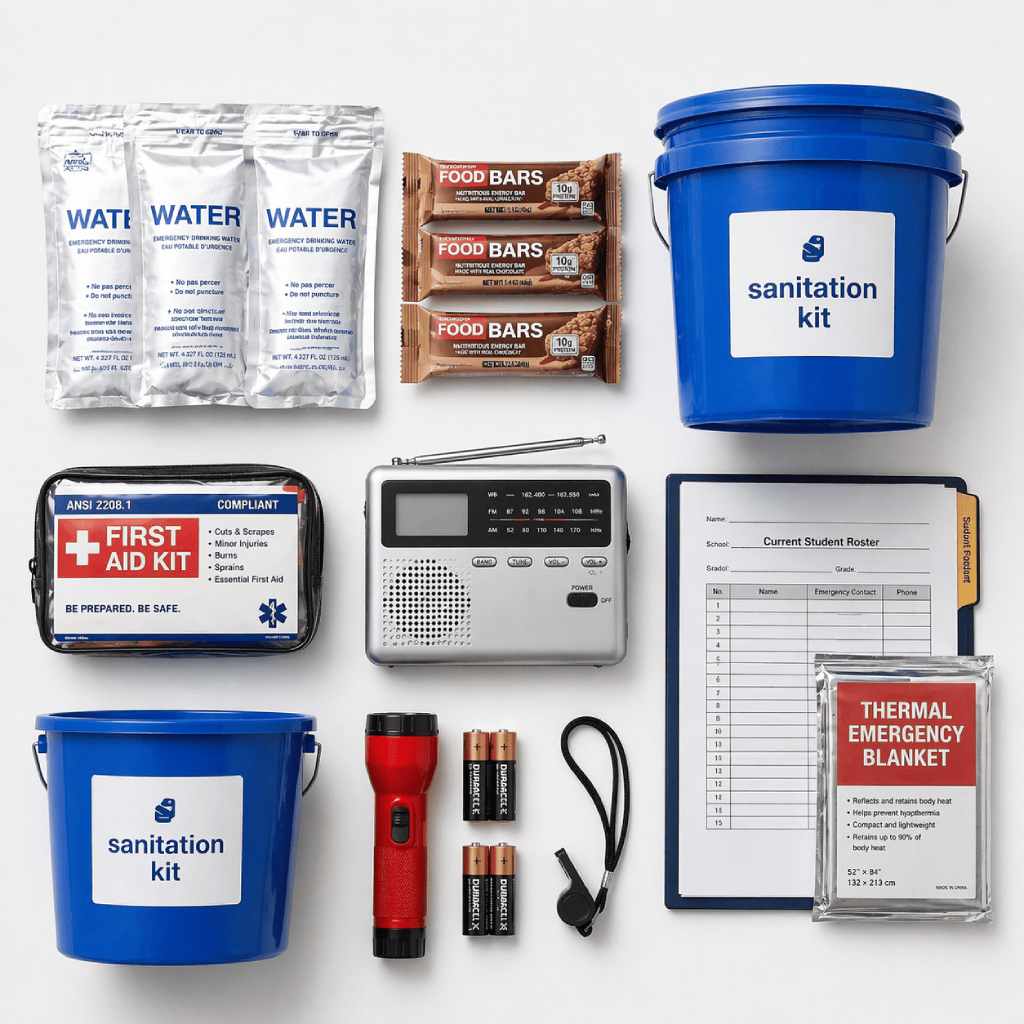
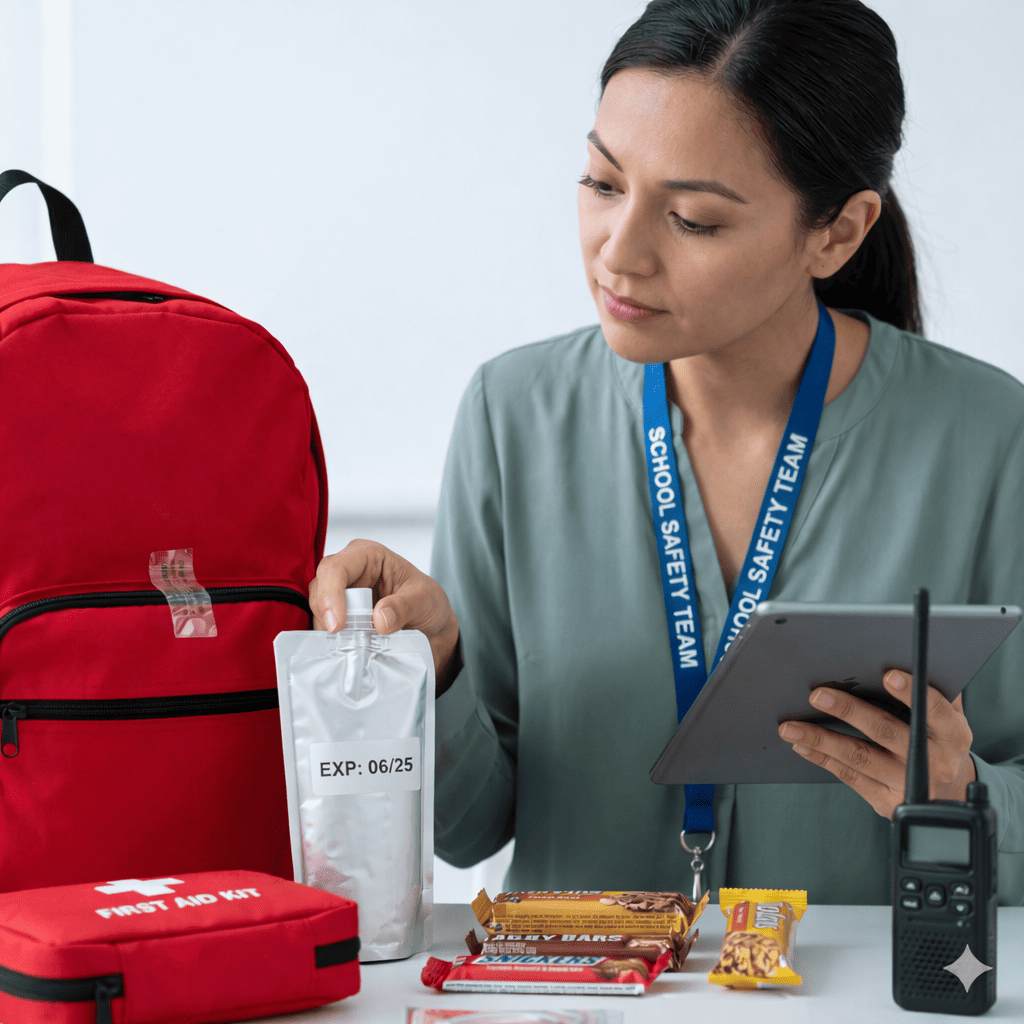
Core Supplies Every Kit Must HaveProcurement specifications should reference federal guidance as the baseline and district policy as the ceiling. The following core list of essential items is drawn from REMS, CDC, and American Red Cross preparedness standards. These are the basic, crucial supplies that every school kit must include:
Optional Add-Ons Based on School Size and Risk ProfileDistrict geography, campus layout, and student population determine what goes beyond the core list:
Classroom Kits vs. Campus-Wide Emergency Kits — What's the Difference?
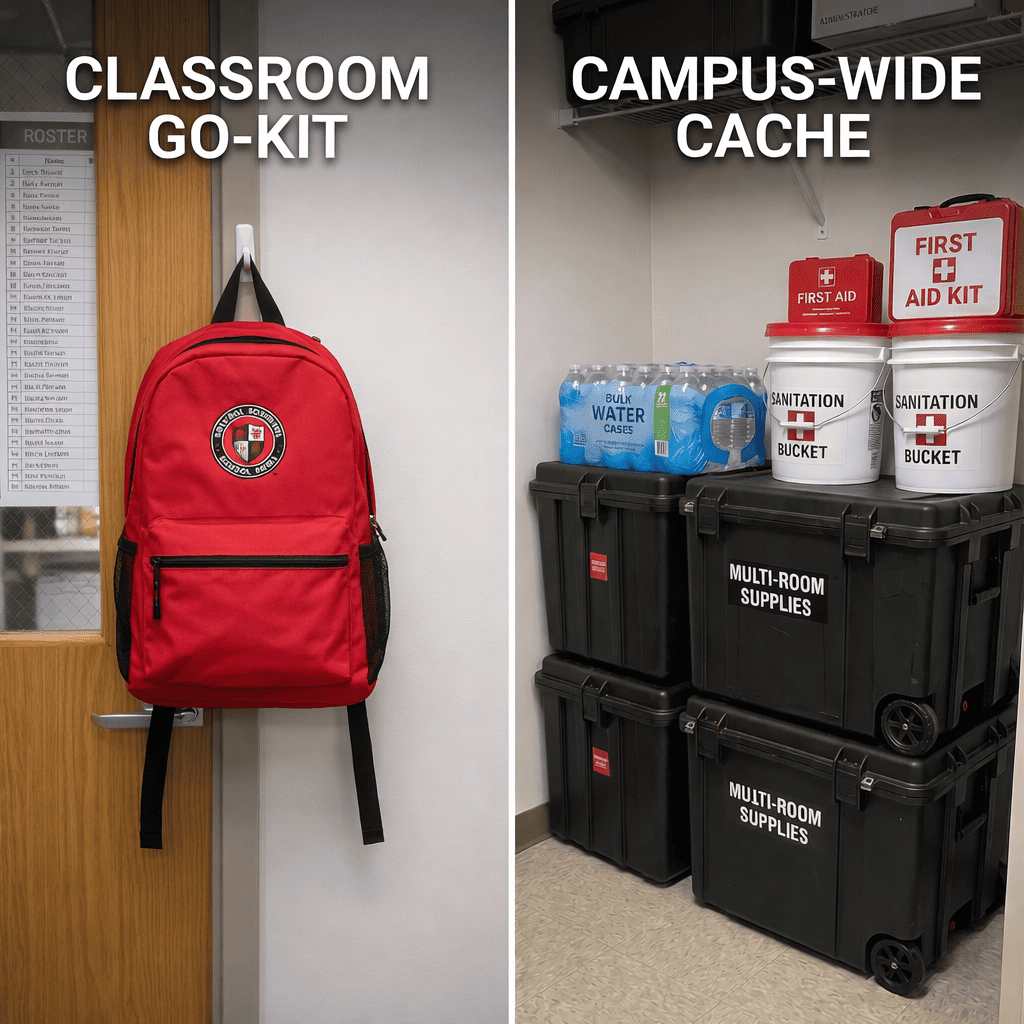
REMS guidance distinguishes two primary deployment tiers, and both are required for a complete system: Classroom go-kits are staged at the point of instruction—typically a backpack or bucket hung near the door. They are designed for immediate use by a single teacher and their students during lockdown or shelter-in-place. Contents are compact, age-appropriate, and include teacher-specific accountability tools like the class roster, evacuation diagram, and buddy assignments. Administration/campus-wide kitsare staged in a central location accessible to incident command staff. They carry expanded supplies—megaphones, master keys, walkie-talkies, parent-student reunification plans, portable toilets, and command documentation—for managing a multi-room or multi-building event. A district that only stocks one tier is under-prepared. Classroom kits fail if the teacher lacks immediate access. Campus kits fail if incident commanders lack the tools to coordinate across a building. How to Calculate How Many Kits Your School NeedsUse a simple tiered formula for calculating school emergency kit per student and per campus requirements:
LAUSD operationalizes this with a ratio-based standard—one first aid kit per 400 individuals on campus—as a model for how district policy can translate federal requirements into actionable numbers. What to Look for in a School Emergency Kit Supplier
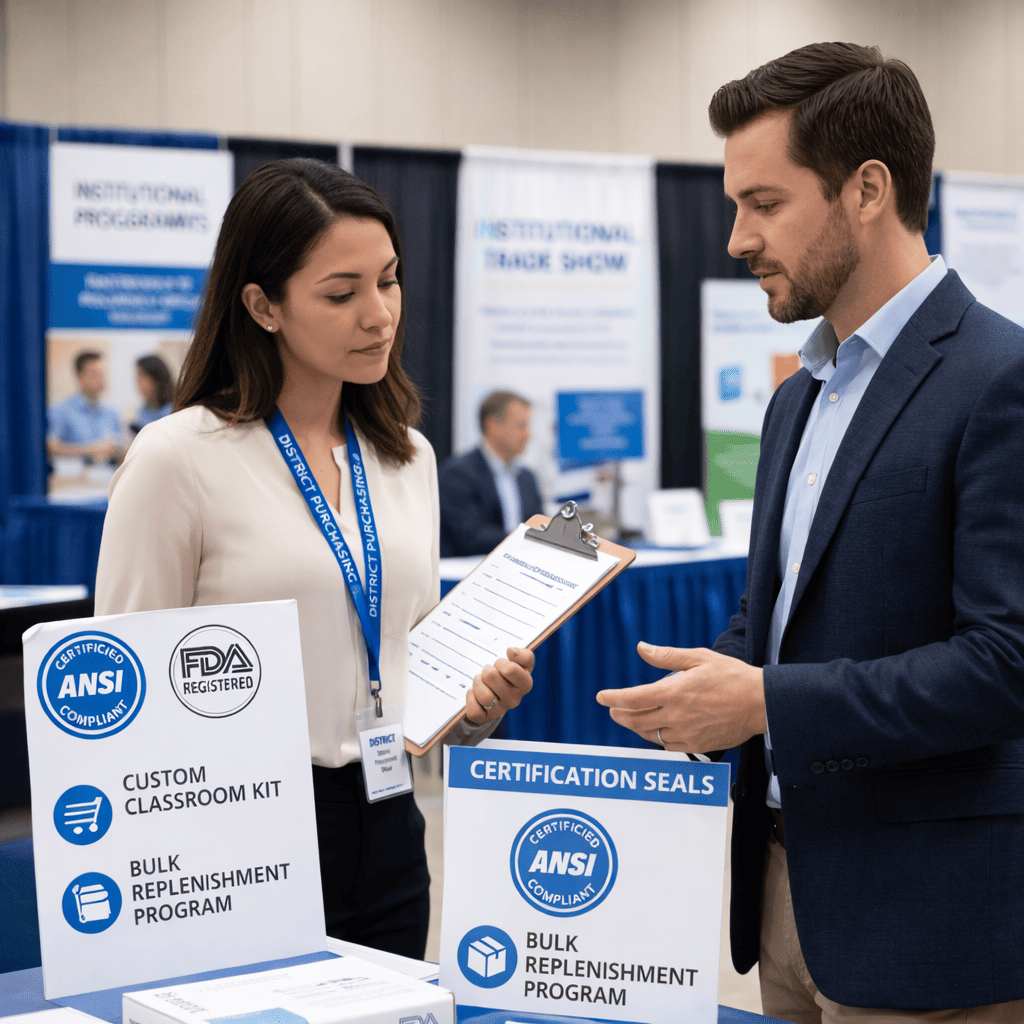
Product Quality and CertificationsAsk for documentation, not marketing language. Campus security and student safety depend on supplies that perform when needed. A qualified supplier should be able to show:
Tamper-evident seals, expiration date labeling by lot, and labeled storage temperature ranges are operational necessities—not premium features. Customization and Compliance SupportA qualified supplier can build kits to your district's emergency operations plan, not just offer pre-packaged SKUs. Districts should learn what customization options each vendor offers before committing to a contract. This means adjusting quantities per occupancy data, including IEP- or 504-driven accessibility items, and configuring accountability tools (roster holders, identification vests, command checklists) to match your incident command structure and team response practices. Ask whether the supplier has worked with other districts in your state and whether they understand your specific state statute's requirements. Bulk Pricing and Volume DiscountsLarge-scale procurement changes the math significantly. Districts should negotiate:
Red Flags to Watch for When Evaluating Suppliers
How to Request and Compare Supplier QuotesComparing school emergency kit suppliers requires normalizing quotes using a standard RFQ structure. Issue the same specification to all vendors and evaluate on identical terms:
Maintaining and Replacing Your School Emergency Kits
Kit maintenance is where most districts fall short after initial procurement. REMS guidance explicitly requires designated staff responsible for replenishment, labeled and organized storage, and integration of kit location with drill exercises. Minimum maintenance program elements:
After each drill, document any gaps surfaced — a kit that wasn't accessible, a roster that was out of date, a sanitation item that had expired. These findings should feed directly into your next supplier conversation or restocking order. A drill that reveals a gap is procurement intelligence; a drill report that sits in a folder is a missed opportunity to improve readiness. Ready to see what a district-grade kit program looks like? SOS Products supplies classroom lockdown kits, campus-wide emergency caches, and restocking programs to K–12 districts nationwide. Request a catalog to review kit configurations, volume pricing, and replenishment options for your district. For those who want the full technical breakdown, continue below.School Emergency Kits vs. General Emergency Preparedness Kits — What's DifferentSchool emergency kits are institutional-grade survival systems designed for group occupancy, regulatory compliance, and duty-of-care accountability—not individual household use. School emergency kits differ from consumer kits in population density requirements, regulatory compliance demands, and role-based supply architecture. They must account for students with disabilities, align with district emergency operations plans, and meet OSHA workplace first aid standards, while supporting multi-day sustainment, accountability documentation, and structured restocking programs. --> Household preparedness guides—including those from the American Red Cross and CDC—are built on a per-person planning model. A single-family kit for 72 hours contains 3 gallons of water, a first aid kit, and a battery radio. A classroom kit for 30 students requires:
The supply density, occupancy variables, and compliance requirements make school procurement categorically different from retail emergency supply shopping. A vendor that primarily sells to individuals may not be configured for institutional delivery, lot-level expiration tracking, or custom kit builds against a district's EOP. Buying Emergency Kits for Schools in Bulk: Wholesale and Volume OptionsInstitutional purchasing for K–12 districts operates on procurement cycles—not impulse buys—and volume logistics require a supplier with the infrastructure to match. Wholesale and bulk emergency kit purchasing for school districts involves cooperative contracts, purchase orders, minimum order quantities, and annual supply agreements. Districts can reduce per-unit costs and procurement cycle time by using cooperative purchasing frameworks while maintaining competitive compliance through structured RFQ processes. Per-Student vs. Per-Classroom Kit Pricing — Which Model Saves MoreTwo primary pricing models exist in the school emergency supply market: Per-student pricing calculates kit cost based on the number of students in the population the kit must serve. This model aligns with district-level planning documents and makes compliance reporting straightforward. However, per-student pricing can underestimate total cost when classroom populations vary significantly (e.g., a 12-student special education room vs. a 35-student general education classroom). Per-classroom pricing delivers a standardized kit to each instructional space regardless of occupancy. This is operationally simpler and ensures no classroom is left without supplies. The per-unit cost is higher in absolute terms but eliminates the variability problem and simplifies inventory audits. For most districts, a hybrid approach makes the most sense: per-classroom kits for instructional spaces (standardized configuration), with per-student supplemental supplies (water pouches, food bars) added based on actual enrollment per room. Volume discount thresholds typically activate at 50+ units, 100+ units, and 500+ units. Districts with 20 or more campuses should negotiate district-wide contracts rather than campus-by-campus purchases—the aggregate volume qualifies for significantly lower per-unit pricing and enables centralized restocking contracts. Cooperative purchasing offers an alternative to competitive bidding. Cooperative contracts—established by purchasing cooperatives serving public agencies—allow districts to order from pre-vetted suppliers without running a full RFQ process. Districts remain responsible for due diligence on product fit and compliance alignment, but cooperative procurement can compress a 90-day procurement cycle to weeks. Funding Your School Emergency Kit PurchaseBudget constraints are among the most common reasons districts delay kit procurement. Several federal and state funding mechanisms can offset or fully cover the cost. Title IV-A (Student Support and Academic Enrichment Grants) is one of the most broadly applicable federal sources for school safety expenditures, including emergency supplies, safety training, and preparedness materials. Allowable uses are guided by local needs assessments, making kit procurement eligible in districts where emergency preparedness is identified as a priority need. Districts receive Title IV-A funds through their state educational agency annually. COPS Office School Violence Prevention Program (SVPP) provides approximately $73 million annually through FY2026 under the Bipartisan Safer Communities Act. While primarily focused on security infrastructure, eligible expenses include emergency preparedness improvements. Only K–12 primary and secondary schools can apply directly (FEMA Preparedness Grants). FEMA Emergency Management Performance Grant (EMPG) provided $319.5 million in FY2025 to state and local emergency management agencies for all-hazards preparedness. Districts can pursue EMPG-funded support through their county or state emergency management office for joint preparedness initiatives that include school kit programs (FEMA EMPG Program). State-level school safety grants vary significantly by state. Missouri, Nebraska, Texas, and Indiana have recently administered competitive safety grant programs with emergency preparedness as an eligible use. Districts should check with their state department of education annually, as funding cycles open and close each fiscal year. The REMS TA Center maintains a current listing of grant programs relevant to school emergency management at rems.ed.gov/funding. Note: ESSER funding (all three packages totaling $189.5 billion) expired by January 2025 and is no longer available as a procurement pathway. FEMA, OSHA, and State-Level Compliance Requirements for School Emergency KitsUnderstanding the regulatory framework is not optional for procurement leaders—it is the foundation of defensible vendor selection. School emergency kit compliance requirements span OSHA workplace first aid standards, FEMA and NIMS-aligned emergency operations planning, ADA accessibility mandates, and state-level statutes governing drills, planning, and medical readiness. No single federal law mandates a specific classroom kit—compliance is determined by the intersection of multiple overlapping regulatory frameworks. --> OSHA RequirementsOSHA 29 CFR 1910.151 establishes the federal first aid baseline for all employers, including school districts. Key requirements:
OSHA's Emergency Action Plan standard (29 CFR 1910.38) requires written evacuation and emergency procedures and designates staff with rescue and medical duties—roles that require kit access and familiarity. FEMA and NIMS AlignmentThe U.S. Department of Education's K–12 emergency planning guide explicitly notes that school EOPs should align with NIMS principles. FEMA's NIMS framework identifies five resource types relevant to kit procurement:
A supplier that understands NIMS resource management categories can help districts structure their kit architecture to match the resource typing their EOP requires. State-Level RequirementsState mandates vary significantly, but common requirements include:
District procurement staff should review their state's current statute directly and consult with their state's department of education for the most current compliance requirements, as state laws are actively evolving. Emergency Evacuation Kits, Lockdown Kits, and Go-Bags for Schools: What Each Scenario DemandsSchool emergency kits are not interchangeable—different scenarios require different configurations staged in different locations. School emergency scenarios require distinct kit types: lockdown kits support prolonged shelter-in-place with sanitation and food; evacuation go-bags prioritize portability and accountability documentation; 72-hour kits provide multi-day sustainment for extended campus isolation; campus-wide caches support incident command operations. Matching kit type to scenario is a fundamental procurement planning requirement. -->
REMS guidance distinguishes classroom kits from administration kits explicitly and notes that classroom kits should be portable, stored near the exit, and maintained under an assigned replenishment plan. For evacuation kits specifically, portability and grab-and-go configuration are non-negotiable—a kit that cannot be carried out in under 30 seconds by a teacher managing 25 students is not operationally viable. How to Compare School Emergency Kit Suppliers: A Side-by-Side LookA structured comparison framework prevents the common procurement error of selecting on price alone. Evaluating school emergency kit suppliers requires comparing product certifications, customization capability, volume pricing structure, restocking program design, and institutional references. Districts that use a weighted scoring rubric across these categories reduce the risk of selecting a vendor that cannot support multi-year compliance requirements or high-volume logistics.
Districts should request that each supplier complete a standardized response template before scoring. Comparing suppliers who have answered different questions is not a valid evaluation.
FAQWhat should a school emergency kit include?A defensible school emergency kit baseline includes water, non-perishable food, a first aid kit, sanitation supplies, communication tools, and light/power items. For K–12 specifically, kits must also include accountability documentation—student and staff rosters, emergency procedures, reunification plans, and teacher identification vests. According to the U.S. Department of Education's REMS Technical Assistance Center, both classroom and administration kits should be portable, stored in accessible locations, and maintained under an assigned replenishment plan (REMS – Emergency Go-Kit Guidelines). The CDC recommends a minimum of 1 gallon of water per person per day for 3 days, with water replaced every six months (CDC – Emergency Water Supply Guidelines). How many emergency kits does a school need?Most school preparedness guidance supports a two-tier minimum: one classroom kit per instructional space, and one or more campus-wide administration kits per building. Quantity beyond that tier is driven by total campus occupancy, hazard profile, and duration assumptions. LAUSD uses a ratio-based standard—one first aid kit per 400 individuals on campus—as a model for how districts can translate federal requirements into procurement targets. For districts planning for multi-day events, a 72-hour supply calculation (daily supply × number of people × 3 days) establishes total volume requirements for water and food across all kit locations. How often should school emergency kits be replaced or restocked?At minimum, kits should be inspected annually and updated whenever items expire or sustain damage. The REMS fact sheet requires that replenishment responsibilities be designated in the school's emergency plan and that supplies be labeled and tracked. The CDC recommends replacing self-filled stored water every six months (CDC – Emergency Water Storage and Maintenance). For food, check expiration dates at least twice per year. For medications and sterile supplies, follow labeled expiration dates—the FDA defines expiration date as the period during which a product remains stable under labeled storage conditions (FDA – Drug Expiration Dates Q&A). A contracted restocking program with your supplier eliminates manual tracking and reduces the risk of an audit finding expired supplies. What is the best emergency kit supplier for schools and classrooms?There is no universal best supplier—"best" depends on your district's hazard profile, compliance obligations, accessibility requirements, and volume logistics. Student well-being during a crisis depends on the right supplies being in the right place. According to REMS guidance, the most qualified supplier can (a) document alignment with ANSI, FDA, and OSHA standards; (b) build role-based kits tailored to your EOP; (c) provide a replenishment program with scheduled inspections and expiration management; and (d) configure kits for students and staff with access and functional needs. Districts should evaluate on a weighted rubric rather than initial unit price alone. Where can I buy bulk emergency kits for schools at wholesale prices?Districts have three primary procurement pathways for wholesale emergency kits for schools. First, cooperative purchasing contracts—available through regional or national cooperatives serving public agencies—allow districts to order from pre-vetted suppliers without running a full competitive bid, compressing procurement timelines significantly. Second, direct competitive solicitation (RFQ or RFP) allows districts to define exact specifications, require certification documentation, and negotiate multi-year pricing with restocking components included. Third, direct volume agreements with suppliers who offer tiered pricing at defined thresholds (50+, 100+, 500+ units) are appropriate for smaller or single-campus districts that do not need cooperative contract structures. Agencies remain responsible for compliance due diligence regardless of which pathway they use. What do FEMA and state regulations require for school emergency preparedness kits?At the federal doctrine level, FEMA's guidance does not mandate specific kit contents but requires that school EOPs align with National Incident Management System (NIMS) principles—including resource management categories covering personnel, equipment, supplies, facilities, and communications. OSHA 29 CFR 1910.151 requires adequate first aid supplies and trained personnel for all employers, including school districts. At the state level, requirements are jurisdiction-specific and actively evolving. Louisiana law (R.S. 17:416.16) requires annual plan review, safety drills within the first 30 days of each school year, and staff in-service training. Washington OSPI mandates monthly multi-scenario drills. Alyssa's Law—now enacted in more than 10 states—requires silent panic alarms that activate lockdown protocols and kit use. Districts should consult their state department of education directly for current statutory requirements. How do I choose an emergency kit supplier for a large school district?A structured evaluation process protects a large district from procurement errors that are difficult to reverse once a multi-year contract is in place. Begin by defining your kit tier system (classroom + campus + district command), your occupancy data per building, and your planning duration assumption (typically 72 hours). Require all suppliers to respond to a standardized RFQ covering product certification, customization capability, delivery logistics, restocking program pricing, and institutional references. Weight evaluation criteria before scoring—compliance documentation and restocking program design should carry more weight than initial unit price for multi-year contracts. Per the REMS framework, designate an internal staff member responsible for ongoing supplier oversight and annual replenishment certification. Districts with 20+ campuses should negotiate district-wide pricing and delivery staging—room-level or campus-level—rather than managing individual school orders. How much do school emergency kits cost per student or per classroom?Kit pricing varies based on four primary factors: (1) sustainment duration (24-hour vs. 72-hour supply changes water and food volume significantly); (2) medical capability level (a first aid-only kit costs less than one with bleeding control or AED components); (3) kit tier (classroom kits are less expensive than campus-wide administration kits); and (4) whether restocking is included as a service. As a general planning range: basic classroom kits typically run $75–$150 per unit; full 72-hour classroom kits with sanitation run $200–$400; administration/campus-wide kits run $500–$1,200 depending on medical capability. These are illustrative ranges for budget conversations—actual quotes will vary by supplier, volume, and configuration. A 30-classroom elementary school budgeting for full 72-hour kits, for example, would plan roughly $6,000–$12,000 for initial classroom kit procurement before factoring in an administration kit and annual restocking costs. The American Heart Association's Cardiac Emergency Response Plan for Schools notes that AED procurement adds a significant cost variable for large campuses requiring multiple units to meet the 3-minute response goal (AHA – Cardiac Emergency Response Plan for Schools). Because food, water, and some medical supplies expire, lifecycle cost—not initial purchase price—is the accurate measure for budget planning. Districts should request a total cost of ownership estimate (initial kit + annual restocking + inspection) rather than evaluating per-unit kit price in isolation. DisclaimerThis information is provided for general awareness and planning purposes. For emergencies, contact local emergency services immediately. Emergency preparedness procedures and regulations vary by location and change over time. Schools should verify current requirements with their state education agency, local emergency management office, and relevant authorities. Consult qualified safety professionals and follow your district's specific emergency operations plans when implementing emergency preparedness measures. Content TransparencyThis article was human-authored by the SOS Survival Products team based on over 30 years of real-world experience and trusted resources in the emergency preparedness field. |

.jpg)